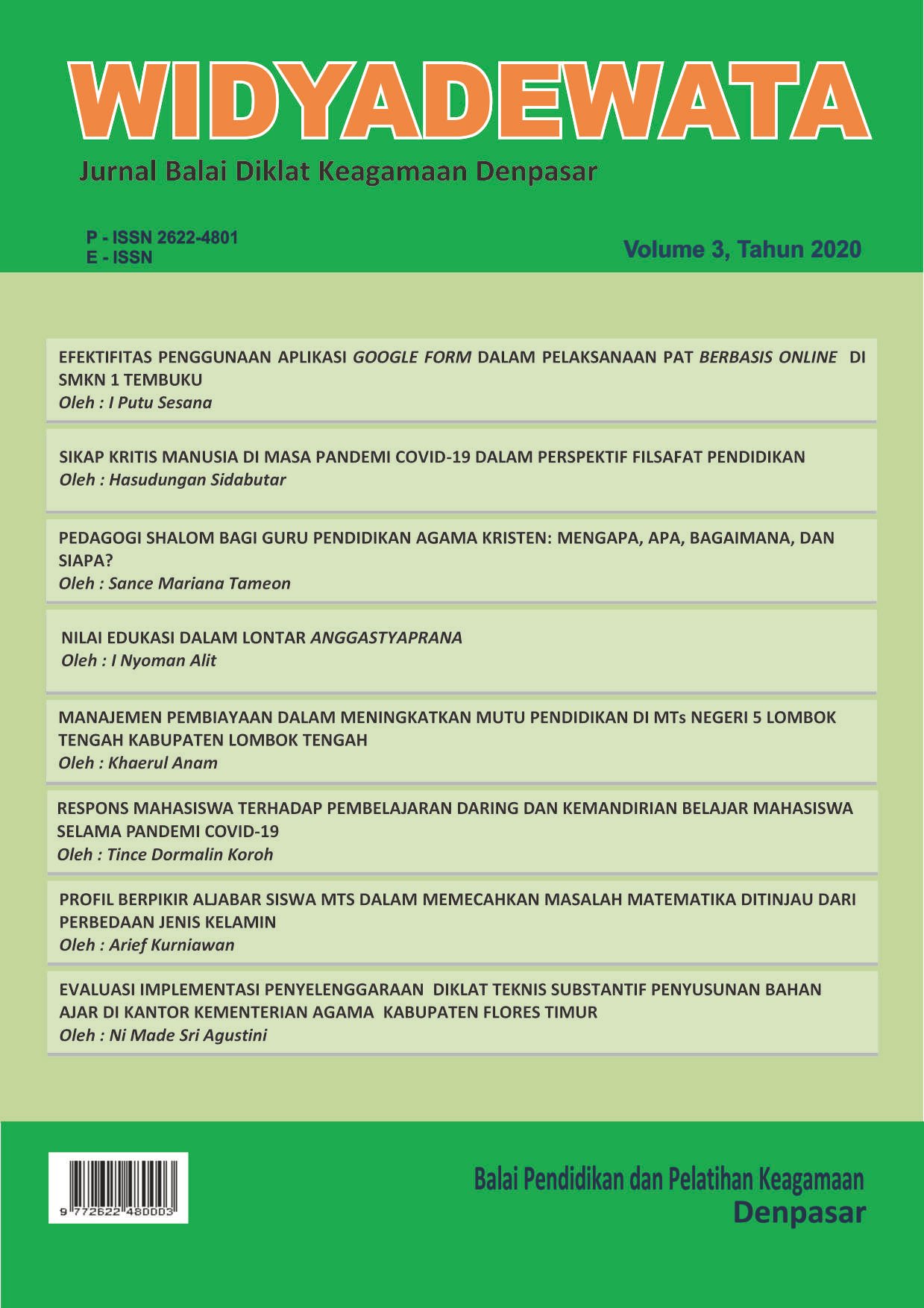
Profil Berpikir Aljabar Siswa MTs Dalam Memecahkan Masalah Matematika Ditinjau Dari Perbedaan Jenis Kelamin
Students Algebraic Thinking Profile In Solving Mathematics Problem Based On Gender
DOI:
https://doi.org/10.47655/widyadewata.v3i1.11Keywords:
Berpikir Aljabar;, Masalah Matematika, Pemecahan Masalah, Jenis KelaminAbstract
Penelitian ini bertujuan untuk mendeskripsikan profil berpikir aljabar siswa dalam memecahkan masalah matematika berdasarkan jenis kelamin melalui tiga tahap pemecahan masalah (mengekstraksi informasi dari situasi, representasi matematika, dan menafsirkan dan menerapkan temuan matematika) dan enam indikator berpikir aljabar (generalisasi, abstraksi, berpikir analitis, berpikir dinamis, pemodelan, dan organisasi). Penelitian ini menggunakan pendekatan kualitatif dengan dua subjek penelitian: siswa pria dan siswa wanita dengan kemampuan matematika yang setara. Data penelitian diperoleh melalui wawancara berdasarkan jawaban tugas yang diberikan, hasil wawancara diperiksa validitasnya dengan menggunakan triangulasi waktu dimana subjek diberikan tugas penyelesaian masalah yang setara pada waktu yang berbeda. Hasil penelitian menunjukkan bahwa subjek pria memenuhi enam indikator berpikir aljabar, sedangkan subjek wanita hanya memenuhi lima indikator berpikir aljabar yaitu generalisasi, abstraksi, berpikir dinamis, pemodelan, dan organisasi. Subjek wanita tidak menunjukkan berpikir analitik dalam memecahkan masalah. Peneliti menyarankan hasil penelitian ini dapat digunakan oleh guru untuk mengembangkan dan melatih berpikir aljabar kepada siswa mereka.
This study aimed to describe students algebraic thinking profile in solving mathematical problems based on gender through three stages of problem solving (extracting information from situation, mathematical representation, and interpreting and applying mathematical findings) and six algebraic thinking indicators (generalization, abstraction, analytical thinking, dynamic thinking, modeling, and organization). This research used qualitative approach with two subjects: male student and female student with equal mathematical ability. Data obtained through based on tasks interviews were checked for validity by using time triangulation that is assigned equivalent problem-solving tasks at different times. The results showed that the male subject met the six indicators of algebraic thinking, while the female subject met the five algebraic thinking indicators of generalization, abstraction, dynamic thinking, modeling, and organization. She did not show analytic thinking in solving problems. Researcher suggests the results of this study can be used by teachers to develop and train algebraic thinking to their students.
Downloads
References
Windsor, W. 2009. Algebraic Thinking-More to Do w.ith Why, Than X and Y .Journal For Research In Mathematics Education p. 592-595
Booker, G & Windsor, W. 2010 Developing Algebraic Thinking: Using problem Solving To Build From Number and Geometry In The Primary School To The Ideas That Underpin Algebra In High School and Beyond. International Conference on Mathematics Education Research Australia
Kieran, C. 2004. Algebraic Thinking in The Early Grades: What is it? The Mathematics Educator Vol 8 No 1 p. 139-687
Windsor, W & Norton, S. 2011. Developing Algebraic Thinking: Using A Problem Solving Approach in A Primary School Context AAMT & MERGA p. 813-820
Posamentier, A. S. & Krulik, S. 2009. Problem Solving in Mathematics Grade 3-6, Powerful Strategis to Deepen Understanding California USA: Corwin
Kamol, N & Har, Y. B. 2010. Upper Primary School Student’ Algebraic Thinking Mathematics Education Research Group of Australasia p. 289-296
Patton, B & Santos, E. D. L. 2012. Analyzing Algebraic Thinking Using “Guess My Number” Problems. International Journal of Instruction Vol 5 No 1 p. 5-22
Atovigba, M. V, Vershima, A. M O’Kwu. E. I. & Ijenkeli, E. 2012. Gender Trends in Nigerian Secondary School Students’ Performance in Algebra. Reserch Journal of Mathematics and Statistic 4(2):42-44
Kyei, L Apam, B & Nokoe, K. S. 2011. Some Gender Differences in Performance in Senior High Mathematics Examinations in Mixed High School. American Journal of Social and Management Sciences 2(4): 348-355
Grassi, C. 2005. Gender-Based Achievement, Self-Confidence, and Enrollment Gaps: Mathematics at Trinity College. Senior Theses Trinity College Hartford
Santrock, JW. 2010. Educational Psychology New York: McGraw-Hill
Walle, J A. V. D., Karp, K. S. & Williams, J. M. B. 2013. Elementary and Middle School Mathematics. Teaching Developmentally New Jersey: Pearson Education Inc Eight edition
Lew, H. C. 2004. Developing Algebraic Thinking in Early Grades: Case Study of Korean Elementary School Mathematics The Mathematics Educator Vol 8 No 1 p. 88-106
Phonapichat, P., Wongwanich, S, & Sujiva, S. 2013. An Analysis of Elementary School Students’ Difficulties in Mathematical Problem Solving. 5th World Conference on Educational Sciences – WCES 2013
Kleden, M. A. 2015. Analysis Of Self-Directed Learning Upon Student Of Mathematics Education Study Program. Journal of Education and Practice Vol 6 No 20
Windsor, W. 2010 Algebraic Thinking: A Problem Solving Approach Len Sparrow Barry Kissane and Chris Hurst (Ed.) Shaping the Future of Mathematic Education Proceeding of the 33rd Annual Conference of the Mathematics Education Research Group of Australia. John Curtin College of the Arts, Freemantle, 3-7 Juli 2010
Herbert, K. & Brown, H. 2000. Pattern As Tools for Algebraic Reasoning Algebraic Thinking, Grades K-12: Reading from NCTMs School-Based Journals and Other Publications, Barbara Moses (Ed) Reston VA: NCTM
Ameron, B. A. V. 2002 Reinvention Of Early Algebra: Developmental Research On The Transition From Arithmetic to Algebra Doctoral Dissertation Utrecht University
Seeley, C. L. 2004. A Journey in Algebraic Thinking. President’s Message in NCTM News Bulletin September 2004 Reston, VA: National Council of Teachers of Mathematics
Sugiyono. 2012. Metode Penelitian Kualitatif R & D. Bandung: Alfabeta.
Nafi’an, M. I. 2011. Kemampuan Siswa Dalam Menyelesaikan Soal Cerita Ditinjau Dari Gender Di Sekolah Dasar. Makalah Seminar Nasional Matematika dan Pendidikan Matematika, FMIPA UNY