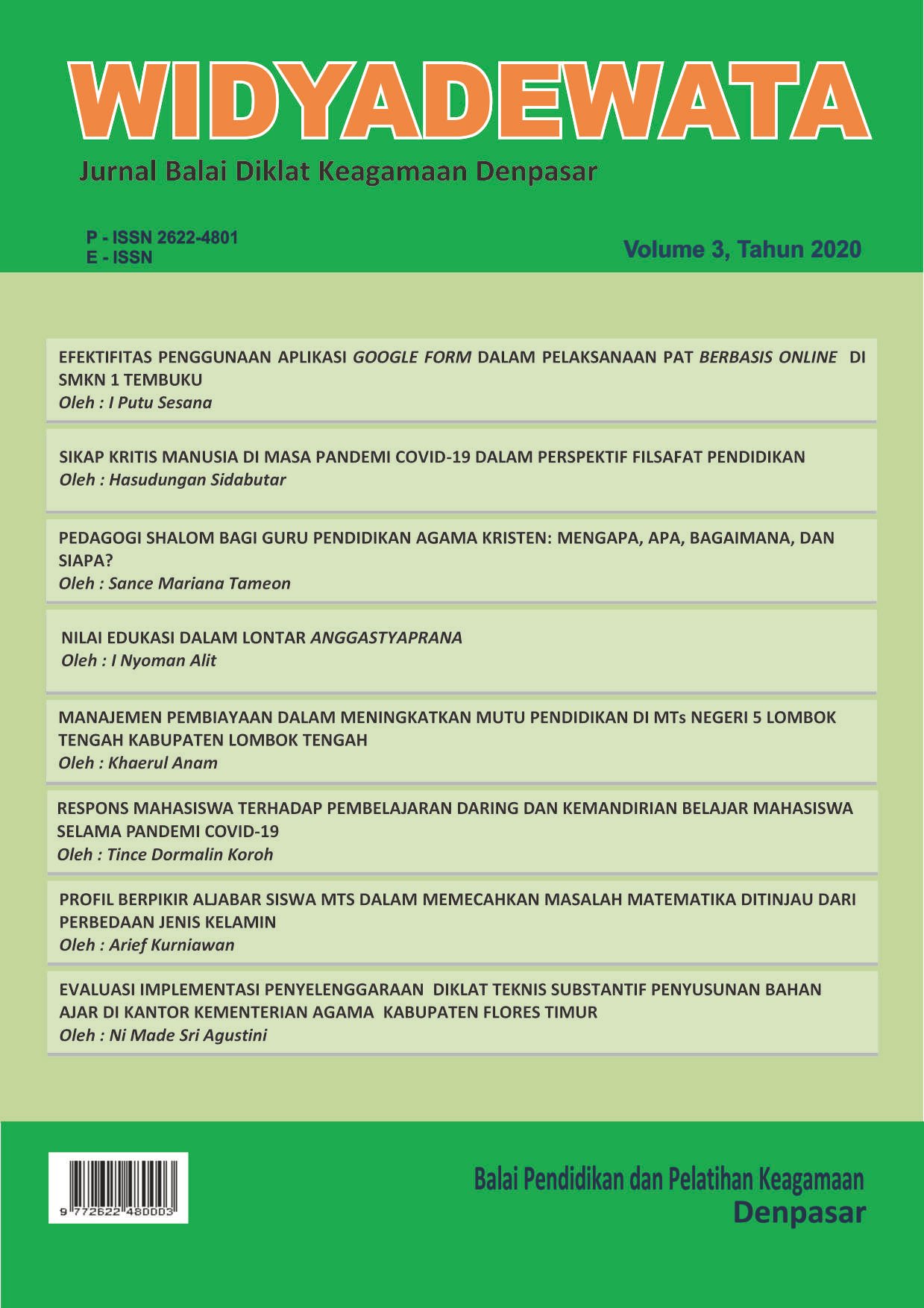
Pedagogi Shalom bagi Guru Pendidikan Agama Kristen: Mengapa, Apa, Bagaimana, dan Siapa?
DOI:
https://doi.org/10.47655/widyadewata.v3i1.14Keywords:
Pedagogi Shalom, Rekonsiliasi, Kontekstualisasi, Discovery Learning, Pemimpin MisionalAbstract
Tujuan studi ini adalah untuk menganalisis peran pedagogi shalom bagi guru pendidikan agama Kristen dalam meningkatkan kompetensi pedagogi. Metode penelitian yang digunakan adalah kualitatif dengan pendekatan literature review. Hasil studi ini menunjukkan bahwa: (1) Tujuan PAK adalah untuk rekonsiliasi dengan Allah, diri sendiri, sesama, dan alam; (2) Konten PAK berbasis pada kontekstualisasi (multikultural) bukan netral, universal, kebiasaan, tradisi, dan adat istiadat; (3) Metode PAK yang perlu diterapkan adalah discovery, bukan individual centered (mouth-to-mouth), kompetisi, menghafal dan kepatuhan buta; (4) Peran, fungsi, dan tanggung jawab guru adalah guru sebagai pemimpin missional, bukan teknisi atau mesin.
The purpose of this study is to analyze the role of the pedagogy of shalom for the Christian education teacher in improving pedagogy competence. The research methods used are qualitative with the approach literature review. The results of this study showed that: (1) the goal of Christian religious education is for reconciliation with god, oneself, neighbor, and nature; (2) the content of Christian religious education is based on contextual (multicultural) rather than neutral, universal, customs, traditions, and customs; (3) the method of Christian religious education that needs to be applied is discovery, not individual centered, competition, blind memorization and obedience; (4) the roles, functions, and responsibilities of a teacher are teachers as professional leaders, not technicians or machines.
Downloads
References
Burbules, N. C. (2005). Jesus as a teacher. Retrieved April 3, 2020, from http://faculty.ed.uiuc/burbules/papers/jesus.htm
Browne M and Keeley SM. (2012) Asking the Right Question: A Guide to Critical Thinking. New Jersey: Pearson Education, Inc.
Chin, Christine & Jonathan Osborne (2008) Students' questions: a potential resource for teaching and learning science. Studies in Science Education 44(1): 1-39. DOI: https://doi.org/10.1080/03057260701828101
Cotton K (2001) Classroom questioning. North West Regional Educational Laboratory.
DeYoung, Curstiss, Paul, 2012, Biblical Reconciliation as God’s One- Item Agenda: Broad Reflections On The Doctrine and Practice, The Anderson University School of Theology, Anderson, Indiana.
Duffy, T.M., & Cunningham, D.J. (1996). Constructivism: Implications for the design and delivery of instruction. In D.J. Jonassen (Ed.). Handbook of Research for Educational Communications and Technology (pp. 170-198). New York: MacMillan Library Reference.
Etemadzadeh A, Seifi S and Far HR (2013) The Role of Questioning Technique in Developing Thinking Skills: The Ongoing Effect on Writing Skill. Procedia - Social and Behavioral Sciences 70: 1024 – 1031.
Feng Z (2013) Using Teacher Questions to Enhance EFL Students’ Critical Thinking Ability. Journal of Curriculum and Teaching 2(2): 147-153. DOI: http://dx.doi.org/10.5430/jct.v2n2p147
Giroux, Henry, A., 2011, On Critical Pedagogy, The Continuum International Publishing Group, London
Gopin, Marc, (2002), Holy War Holy Peace: How Religion Can Bring Peace to the Middle East, Oxford University Press, New York.
Gruchy, John, W, de, (2011). Reconciliation: Restoring Justice (Minneapolis: Fortress Press, 2002), 51 & Samuel George Hines, “The Theme of My Life,” in Samuel George Hines and Curtiss Paul DeYoung, Beyond Rhetoric, Reconciliation as a Way of Life, Eugene, Wipf & Stock
Kaelan. (2005). Metode Penelitian Filsafat. Yogyakarta: Paradigma.
Katongole, Emmanuel, & Chris, Rice, 2008, Reconciling All Things: A Christian Vision for Justice, Peace and Healing, IVP, Downers Grove.
King A (1995) Designing the Instructional Process to Enhance Critical Thinking Across the Curriculum. Teaching of Psychology 22(1): 13-17. DOI: http://dx.doi.org/10.1207/s15328023top2201_5
Lee, Heekap, & Paul Kaak (eds), 2017, “The Pedagogy of Shalom: Theory and Contemporary Issues of a Faith-Based Education”, International Journal of Christianity & Education Vol. 21(3), DOI: 10.1177/2056997117729621.
Lee, HeeKap, 2017, The Pedagogy of Shalom: What, How, Why, and Who of Faith-Based, Springer Nature, Singapore.
Lee, HeeKap, 2014, “What Happened in Aslan’s Classroom?”, Christian Educators Journal 54(2).
Lee H and Roso C (2010) Jesus and Bloom: How effective was Jesus in requiring people to think critically. In: H. Lee (ed) Faith-based Education that Constructs. Eugene, OR: Wipf and Stock, pp. 103-123
Marcuse, H., 1994, Der eindimensionale Mensch: Studien zur Ideologie der fortgeschrittenen Industriegesellschaft, Deutscher Taschenbuchsverlag, München.
Nappi JS (2017) The Importance of Questioning in Developing Critical Thinking Skills. Delta Kappa Gamma Bulletin 84(1): 30-41.
Powell, M. A. (1995). God with us: A Pastoral theology of Matthew’s Gospel. Minneapolis: Fortress Press.
Paul R and Elder L (2002) Critical thinking: Tools for taking charge of your professional and personal Life (2nded.). USA: Sage Publications.
Priyono, B. Herry, (2007), Sesudah Filsafat, Kanisius, Yogyakarta
Rahman, M. H. (2014). Professional Competence, Peagogical Competence and the Performance of Junior High School of Science Teachers. Journal of Education and Practice, 5 (9), 75-80.
Rashid S and Qaisar S (2016) Developing Critical Thinking through Questioning Strategy among Fourth Grade Students. Bulletin of Education and Research 38(2): 153-168.
Samosir, Rotua. (2019). Guru Pendidikan Agama Kristen yang Profesional. Jurnal Pionir LPPM Universitas Asahan Vol. 5 No. 3, 64-68.
Santoso T, Yuanita L and Erman E (2018) The Role of Student's Critical Asking Question in Developing Student's Critical Thinking Skills. IOP Conf. Series: Journal of Physics: Conf. Series 953 012042. DOI: 10.1088/1742-6596/953/1/012042
Sobon, K. (2018). Ethical action of a teacher in Levinas’ ethics of responsibility. International Journal of Ethics Education 3, 157–168. https://doi.org/10.1007/s40889-018-0056-4
Undang-Undang Republik Indonesia Nomor 14 Tahun 2005 tentang Guru dan Dosen. Jakarta: Depdiknas
Vella, F., 1994, “Book Review: To know As We Are Known: Education As A Spiritual Journey: By Parker Palmer”. J. Biochemistry anda Molecular Biology Education Volume 22 Issue 1.
Wolterstorff, Nicholas. (2004). Educating for Shalom: Essays on Christian Higher Education. Grand Rapids, Mich: W.B. Eerdmans Pub. Co.
Yulianingsih, Dwiati & Gaol, Lumban, Stefanus M.M. (2019). Keterampilan Guru PAK Untuk Meningkatkan Minat Belajar Murid dalam Proses Pembelajara di Kelas. Jurnal Fidei, Vol. 2, No. 1, 100-119.