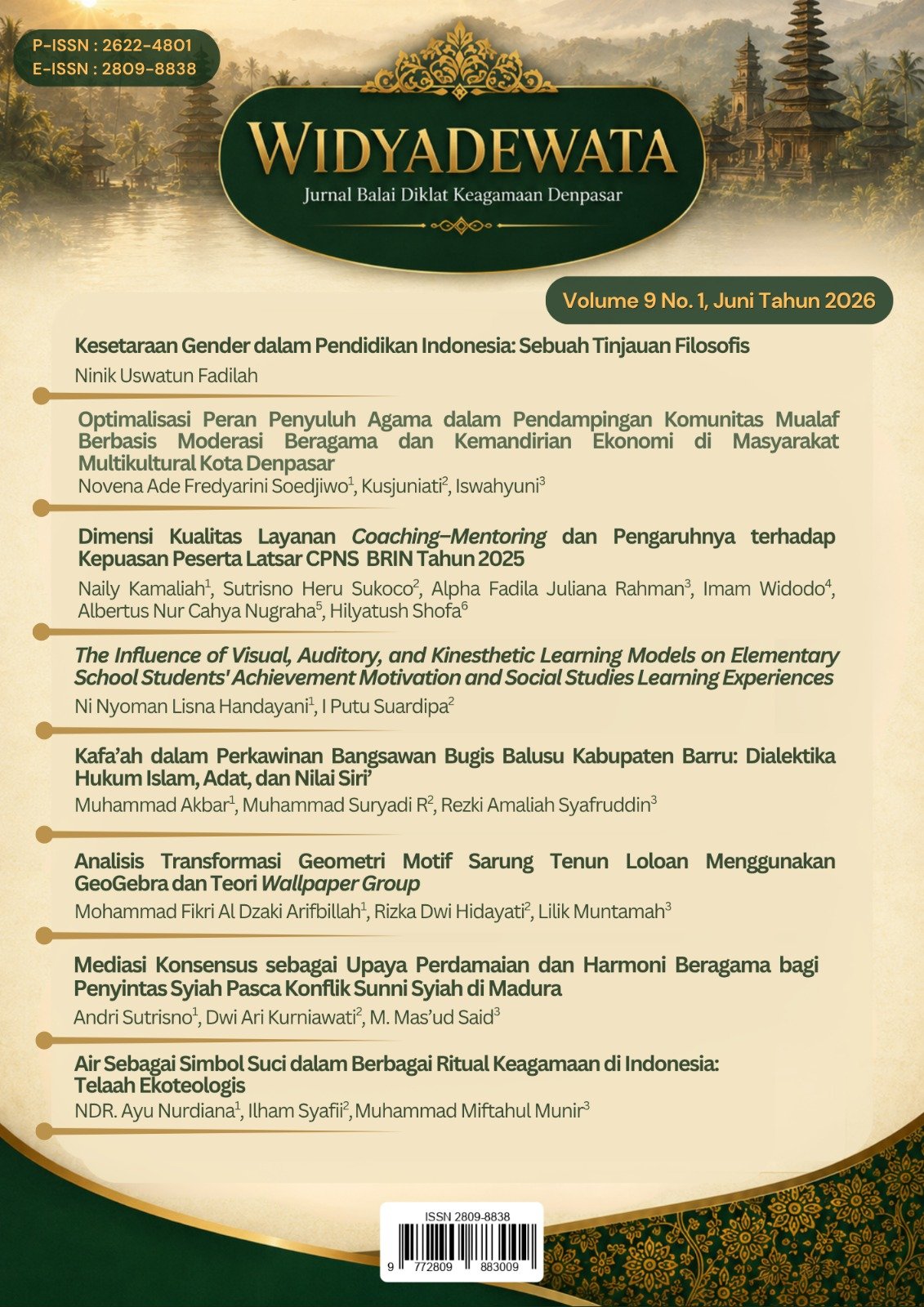
The Influence of Visual, Auditory, and Kinesthetic Learning Models on Elementary School Students' Achievement Motivation and Social Studies Learning Experiences
DOI:
https://doi.org/10.47655/hxpat145Keywords:
VAK Model; Social Studies Concept Mastery; Career MaturityAbstract
This study aims to determine the magnitude of the influence of Visual, Auditory, and Kinesthetic
(VAK) Learning Model on achievement motivation and students' learning experience in social
studies learning. This study is a quasi-experimental study with the Posttest-Only Control-Group
Design. The study population was all 42 fifth-grade students of SDN 4 Sudaji. A total of 42 students
were selected as the sample. Achievement motivation data were collected using questionnaires
and learning experience was measured using multiple-choice tests. Data were analyzed using
MANOVA (multivariate Analysis of Variance). The results of the study show that: First, there is
an influence of VAK learning on achievement motivation in fifth-grade students of SDN 4 Sudaji.
The results of the ANOVA test obtained an F value of 132.07 P < 0.05, this means that the
significance value of the calculated F is smaller than the F table of 0.05. Second, there is an effect
of VAK learning on the social studies learning experience of fifth-grade students of SDN 4 Sudaji.
The ANOVA test results obtained an F value of 74.071 P < 0.05, indicating that the calculated F
value is smaller than the F table value of 0.05. Third, there is a simultaneous effect of VAK learning on achievement motivation and learning experience in fifth-grade students of SDN 4 Sudaji. The
MANOVA test results obtained an F value of 45.526 P < 0.05, indicating that the calculated F
value is smaller than the F table value of 0.05. This study contributes to the achievement
motivation and learning experience of fifth-grade students of SDN 4 Sudaji after being taught
using the VAK model.
Downloads
References
Akker, J. van den, Gravemeijer, K., McKenney, S., & Nieveen, N. (2013). Educational design research. Netherlands Institute for Curriculum Development (SLO).
Borg, W. R., & Gall, M. D. (2003). Educational research: An introduction (7th ed.). Allyn & Bacon.
Branch, R. M. (2009). Instructional design: The ADDIE approach. Springer. https://doi.org/10.1007/978-0-387-09506-6
Cohen, J. (1988). Statistical power analysis for the behavioral sciences (2nd ed.). Lawrence Erlbaum Associates.
Creswell, J. W., & Plano Clark, V. L. (2018). Designing and conducting mixed methods research (3rd ed.). SAGE Publications.
Cuevas, J., & Dawson, B. L. (2022). A test of two alternative cognitive processing models: Learning styles and dual coding. Journal of Educational Psychology, 114(3), 479–497. https://doi.org/10.1037/edu0000687
Cuevas, J., & Dawson, B. L. (2022). A test of two alternative cognitive processing models: Learning styles and dual coding. Journal of Educational Psychology, 114(3), 479–497. https://doi.org/10.1037/edu0000687
Darling-Hammond, L., Flook, L., Cook-Harvey, C., Barron, B., & Osher, D. (2020). Implications for educational practice of the science of learning and development. Applied Developmental Science, 24(2), 97–140. https://doi.org/10.1080/10888691.2018.1537791
Darling-Hammond, L., Flook, L., Cook-Harvey, C., Barron, B., & Osher, D. (2020). Implications for educational practice of the science of learning and development. Applied Developmental Science, 24(2), 97–140. https://doi.org/10.1080/10888691.2018.1537791
Direktorat Jenderal Guru dan Tenaga Kependidikan. (2023). Kebijakan pengembangan guru dan tenaga kependidikan menuju pendidikan abad ke-21. Kementerian Pendidikan, Kebudayaan, Riset, dan Teknologi Republik Indonesia.
Farhani, D. (2024). The effectiveness of VAK learning model in improving students’ conceptual understanding and learning motivation. International Journal of Instruction, 17(1), 215–230. https://doi.org/10.29333/iji.2024.17112a
Fleming, N. D., & Baume, D. (2016). Learning styles again: VARKing up the right tree! Educational Developments, 7(4), 4–7.
Fleming, N. D., & Mills, C. (1992). Not another inventory, rather a catalyst for reflection. To Improve the Academy, 11, 137–155. https://doi.org/10.1002/j.2334-4822.1992.tb00213.x
Fosnot, C. T. (2016). Constructivism: Theory, perspectives, and practice (2nd ed.). Teachers College Press.
Gall, M. D., Gall, J. P., & Borg, W. R. (2007). Educational research: An introduction (8th ed.). Pearson Education.
Hake, R. R. (1998). Interactive-engagement versus traditional methods: A six-thousand-student survey of mechanics test data for introductory physics courses. American Journal of Physics, 66(1), 64–74. https://doi.org/10.1119/1.18809
Hirschi, A. (2021). Career adaptability and career success: A meta-analysis. Journal of Vocational Behavior, 126, 103554. https://doi.org/10.1016/j.jvb.2021.103554
Hirschi, A. (2021). Career adaptability and career success: A meta-analysis. Journal of Vocational Behavior, 126, 103554. https://doi.org/10.1016/j.jvb.2021.103554
Jiang, Z., Newman, A., Le, H., Presbitero, A., & Zheng, C. (2023). Career adaptability and career outcomes: A meta-analytic review. Journal of Vocational Behavior, 141, 103835. https://doi.org/10.1016/j.jvb.2023.103835
Jiang, Z., Newman, A., Le, H., Presbitero, A., & Zheng, C. (2023). Career adaptability and career outcomes: A meta-analytic review. Journal of Vocational Behavior, 141, 103835. https://doi.org/10.1016/j.jvb.2023.103835
Lent, R. W., Brown, S. D., & Hackett, G. (2020). Social cognitive career theory at 25: Empirical status of the interest, choice, and performance models. Journal of Vocational Behavior, 115, 103316. https://doi.org/10.1016/j.jvb.2019.103316
Lent, R. W., Brown, S. D., & Hackett, G. (2020). Social cognitive career theory at 25: Empirical status of the interest, choice, and performance models. Journal of Vocational Behavior, 115, 103316. https://doi.org/10.1016/j.jvb.2019.103316
Mayer, R. E. (2020). Multimedia learning (3rd ed.). Cambridge University Press. https://doi.org/10.1017/9781316941355
Mayer, R. E. (2020). Multimedia learning (3rd ed.). Cambridge University Press. https://doi.org/10.1017/9781316941355
Moreno, R., & Mayer, R. E. (2020). Interactive multimodal learning environments. Educational Psychology Review, 32(3), 717–741. https://doi.org/10.1007/s10648-020-09517-0
Moreno, R., & Mayer, R. E. (2020). Interactive multimodal learning environments. Educational Psychology Review, 32(3), 717–741. https://doi.org/10.1007/s10648-020-09517-0
OECD. (2021). Teachers and school leaders as valued professionals. OECD Publishing. https://doi.org/10.1787/bc58fcf6-en
OECD. (2021). Teachers and school leaders as valued professionals. OECD Publishing. https://doi.org/10.1787/bc58fcf6-en
Paivio, A. (2021). Mind and its evolution: A dual coding theoretical approach. Psychology Press. https://doi.org/10.4324/9781003056227
Paivio, A. (2021). Mind and its evolution: A dual coding theoretical approach. Psychology Press. https://doi.org/10.4324/9781003056227
Pashler, H., McDaniel, M., Rohrer, D., & Bjork, R. (2008). Learning styles: Concepts and evidence. Psychological Science in the Public Interest, 9(3), 105–119. https://doi.org/10.1111/j.1539-6053.2009.01038.x
Putri, R. A., & Nugraha, A. (2020). Career maturity of university students: A study of career planning readiness. Journal of Educational and Social Research, 10(3), 87–94. https://doi.org/10.36941/jesr-2020-0058
Rahmawati, Y., & Lestari, I. (2021). Multisensory learning approach to improve students’ conceptual understanding. Journal of Education and Learning, 15(2), 245–254. https://doi.org/10.11591/edulearn.v15i2.18345
Rudolph, C. W., Lavigne, K. N., & Zacher, H. (2022). Career adaptability: A meta-analysis of relationships with career outcomes. Journal of Vocational Behavior, 134, 103690. https://doi.org/10.1016/j.jvb.2022.103690
Rudolph, C. W., Lavigne, K. N., & Zacher, H. (2022). Career adaptability: A meta-analysis of relationships with career outcomes. Journal of Vocational Behavior, 134, 103690. https://doi.org/10.1016/j.jvb.2022.103690
Savickas, M. L. (2015). Career construction theory and practice. In S. D. Brown & R. W. Lent (Eds.), Career development and counseling (2nd ed., pp. 129–163). Wiley.
Savickas, M. L., Porfeli, E. J., Hilton, T. L., & Savickas, S. (2021). Career adaptability and career construction: Theory and research. Journal of Vocational Behavior, 127, 103475. https://doi.org/10.1016/j.jvb.2021.103475
Sugiyono. (2019). Metode penelitian dan pengembangan (Research and Development/R&D). Alfabeta.
Supardi. (2014). Pembelajaran IPS: Konsep dan implementasi. PT Remaja Rosdakarya.
Suryani, E., & Rochintaniawati, D. (2019). Difficulties in learning social studies concepts among pre-service teachers. Journal of Social Studies Education Research, 10(2), 1–17.
Tabachnick, B. G., & Fidell, L. S. (2013). Using multivariate statistics (6th ed.). Pearson Education.
Downloads
Published
Issue
Section
License
Copyright (c) 2026 lisna handayani, Suardipa I Putu

This work is licensed under a Creative Commons Attribution-NonCommercial-ShareAlike 4.0 International License.