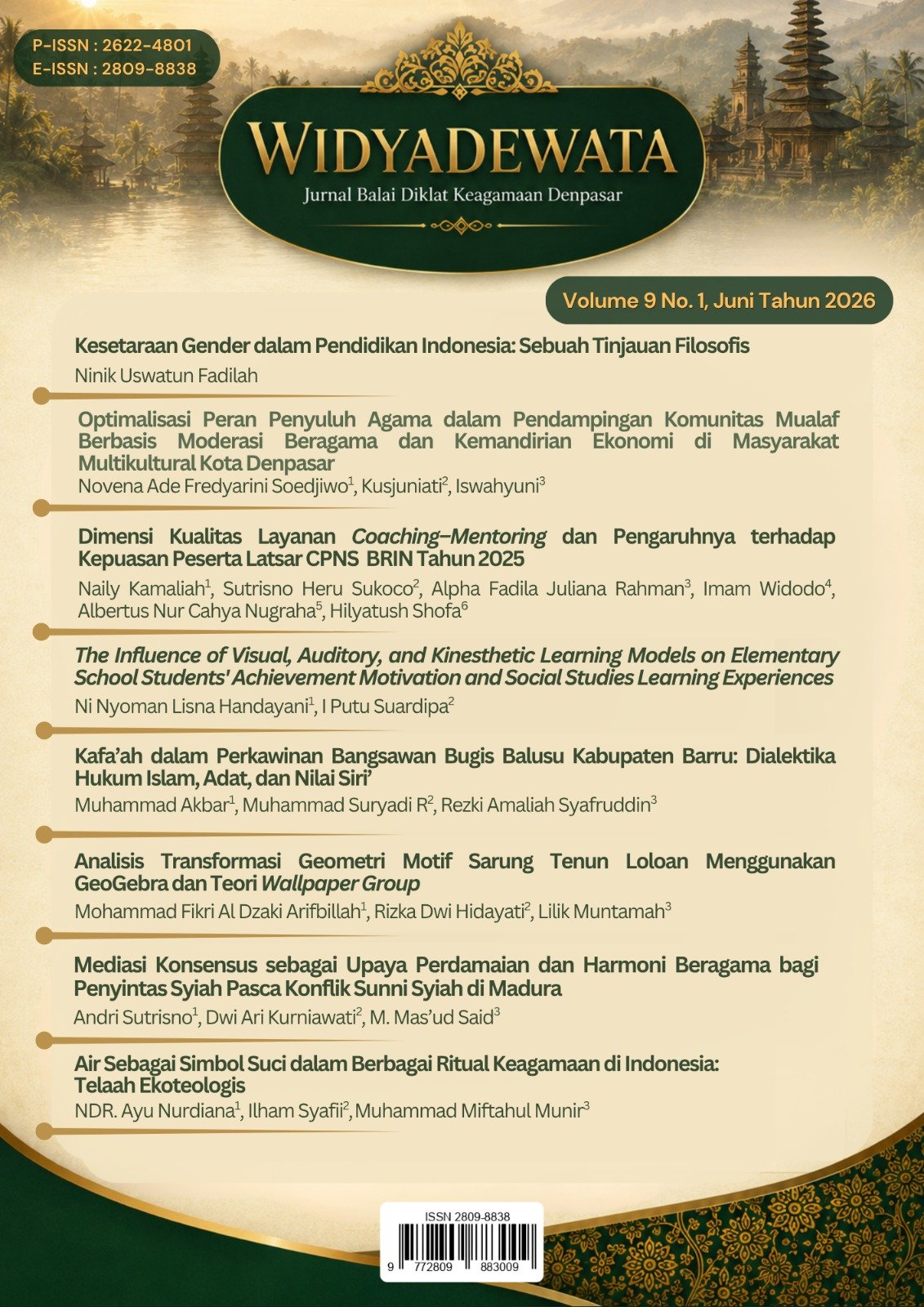
Mediasi Konsensus sebagai Upaya Perdamaian dan Harmoni Beragama bagi Penyintas Syiah Pasca Konflik Sunni Syiah di Madura
DOI:
https://doi.org/10.47655/z9smk967Keywords:
Consensus Mediation; Peace; Religious Harmony; Shia Survivors;Abstract
This study was motivated by the complexity of post-conflict Sunni-Shia reconciliation in Indonesia, with a case study of the Shia Survivor Community in Omben Subdistrict, Sampang Regency. The research problem focused on how consensus-based peacebuilding after the conflict was constructed, as well as the supporting and inhibiting factors that influenced the process towards religious harmony. The objective of the research is to understand and analyze the mechanisms of consensus mediation and the social dynamics underlying efforts to restore intergroup relations. Using a descriptive qualitative approach with field studies, data were collected through observation, in-depth interviews, and documentation studies, then analyzed interactively through reduction, presentation, and conclusion drawing. The results of the study reveal that sustainable peace is built through practical social consensus mediation, supported by three main pillars: (1) negotiation of collective identity towards a shared cultural identity as Madurese people, (2) women's agency in the domestic-economic sphere that builds bridging social capital, and (3) the recontextualization of spirituality that internalizes peace as a shared ethic. This process is driven by practical awareness (rational choice), local socio-cultural capital, and the role of mediators; however, it is simultaneously hampered by ingrained stigma and collective trauma that has not yet healed. This peace construction offers a model of coexistence that is relevant to post-conflict Muslim communities, born out of micro-consensus at the grassroots level.
Downloads
References
Abdussamad, Z. (2021). Metode Penelitian Kualitatif (I, Ed.). CV. Syakir Media Press.
Abidin, A. Z., Fuadi, I., Kholis, N., & Aziz, T. (2020). Between Conflict and Peace: The Government Policies and Sunni-Shia Relationship in Sampang and Yogyakarta. Esensia Jurnal Ilmu-Ilmu Ushuluddin, 21(2), 135–150. https://doi.org/10.14421/esensia.v21i2.2243
Ali, F. V. A. (2019). INTRA-RELIGIOUS DIALOGUE IN POST-SECTARIAN VIOLENCE: Assessing Sampang Sunni-Shiite Relation in Indonesia. Al-Tahrir Jurnal Pemikiran Islam, 18(2), 243. https://doi.org/10.21154/altahrir.v18i2.1377
Allport, G. W. (1954). The Nature of Prejudice. Addison-Wesley.
Bar-Tal, D. (2000). From Intractable Conflict Through Conflict Resolution To Reconciliation: Psychological Analysis. Political Psychology, 21(2), 351–365.
Basri, A. (2025). Wawancara dengan Ahmad Basri (45 tahun), tokoh komunitas Syiah, Omben.
Castells, M. (1997). The Power of Identity. Blackwell.
Cockburn, C. (2007). From Where We Stand: War, Women’s Activism and Feminist Analysis. Zed Books.
Coleman, J. S. (1990). Foundations of Social Theory. Harvard University Press.
Dharma, F. A. (2021). Barriers of Intercultural Communication in the Sunni-Shi’a Conflict in Madura. Kanal Jurnal Ilmu Komunikasi, 10(1), 16–21. https://doi.org/10.21070/kanal.v9i3.1577
Giddens, A. (1984). The Constitution of Society: Outline of the Theory of Structuration. University of California Press.
Goffman, E. (1963). Stigma: Notes on the Management of Spoiled Identity. Prentice-Hall.
Hasanuddin. (2025). Wawancara dengan Hasanuddin (50 tahun), mantan pengikut Syiah, Omben.
Hazim, H. (2015). Social and Psychosocial Impacts for Refugees Post Conflict Between Sunni—Shia in Sampang Madura. Jurnal Psikologia, 3(1), 01–17. https://doi.org/10.21070/10.21070/psikologia.v3i1.107
Ikmal, N. M. (2021). Sunni‑Syiah Conflict in Sampang, Madura: The Politics of Identity. Jurnal Studi Sosial Dan Politik, 5(1), 0.
Kusumastuti, A., & Khoiron, A. M. (2019). Metode penelitian kualitatif. Lembaga Pendidikan Sukarno Pressindo (LPSP). https://books.google.com/books?hl=id&lr=&id=637LEAAAQBAJ&oi=fnd&pg=PA1&dq=metode+penelitian+kualitatif+pustaka&ots=x42mo7n3px&sig=ROvEL0nrUmzSBBMQD3eX3IL4als
Lederach, J. P. (1997). Building Peace: Sustainable Reconciliation in Divided Societies. United States Institute of Peace Press.
Maimun, M., Suhendrayatna, Abdullah, I., Yusuf, R., Syamsulrizal, Sanusi, S., Putra, I., & Avcı, G. (2025). Religion and Local Culture. Jurnal Civics Media Kajian Kewarganegaraan, 22(2), 253–267. https://doi.org/10.21831/jc.v22i2.87874
Maskuri, Mustafida, F., & Andriyansyah, M. F. (2025). The Portrait of Social Capital and Conflict Reconciliation for Peace in Sunni-Shia Relationships: Evidence From Sampang Madura, Indonesia. Journal of Ecohumanism, 3(8). https://doi.org/10.62754/joe.v3i8.5752
Miles, M. B., & Huberman, A. M. (1994). Qualitative Data Analysis: An Expanded Sourcebook (2nd ed.). Sage Publications.
Miles, M. B., Huberman, A. M., & Saldana, J. (2020). Qualitative Data Analysis: A Methods Sourcebook. Sage Publications.
Munawarah, L. (2025). Wawancara dengan Laila Munawarah (42 tahun), ibu rumah tangga, Omben.
Putnam, R. D. (2000). Bowling Alone: The Collapse and Revival of American Community. Simon & Schuster.
Roosinda, F. W., Lestari, N. S., Utama, A. G. S., Anisah, H. U., Siahaan, A. L. S., Islamiati, S. H. D., Astiti, K. A., Hikmah, N., & Fasa, M. I. (2021). Metode penelitian kualitatif. Zahir Publishing. https://books.google.com/books?hl=id&lr=&id=xmtgEAAAQBAJ&oi=fnd&pg=PA1&dq=metode+penelitian+kualitatif+pustaka&ots=utKnoTHIc8&sig=YiCSRVZu7eh8JSW4ZQN5hdLNsUE
Ruagadi, H. A., Nursinah, N., Bunga, N. I., Pelima, J. N., & Taariwuan, S. A. (2024). Social Harmony in Plural Society (Study of Social Integration Post Poso Conflict). International Journal of Health Sciences, 2(2), 767–782. https://doi.org/10.59585/ijhs.v2i2.405
Said, M. (2025). Wawancara dengan M. Said (55 tahun), Kyai Sunni, Omben.
Siddiq, A., Imama, L. S., Febriansyah, M., & Hisyam, M. (2023). State Failure and the Sunni-Shia Conflict in Sampang Madura. Al-Albab, 12(2), 207–224. https://doi.org/10.24260/alalbab.v12i2.2824
Zahra, F. (2025). Wawancara dengan Fatimah Zahra (38 tahun), penjual sembako, Omben.
Downloads
Published
Issue
Section
License
Copyright (c) 2026 Andri Sutrisno, Dwi Ari Kurniawati; M. Mas'ud Said

This work is licensed under a Creative Commons Attribution-NonCommercial-ShareAlike 4.0 International License.